Bhutan protected its identity by staying isolated for centuries, and since opening up it has chosen to protect it on purpose. Preserving culture is one of the four pillars of Gross National Happiness. As a result, few places in Asia feel so fully themselves.
Buddhism at the heart of life
Most Bhutanese follow the Drukpa Kagyu and Nyingma schools of Vajrayana Buddhism. Faith shapes the daily rhythm: butter lamps lit at the family altar, prayer wheels turned on the way to work, astrologers consulted before weddings and journeys, and monks invited to bless new homes. Guru Rinpoche, who brought Buddhism to Bhutan in the 8th century, is honoured at Paro Taktsang (Tiger's Nest), Kurjey Lhakhang and hundreds of other sacred sites.
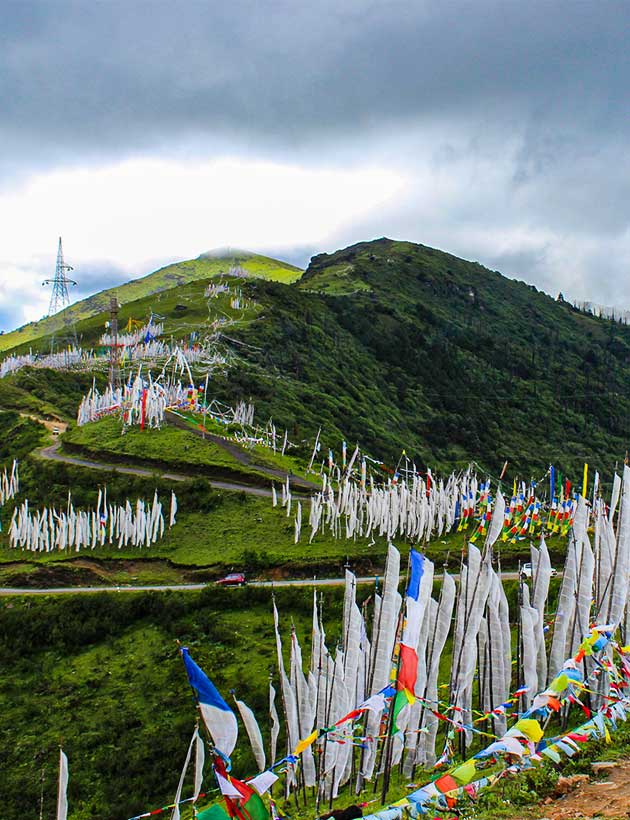
Walk clockwise around chortens, temples and mani walls, as locals do. Prayer flags are hung on high passes so the wind can carry their blessings across the land. White flags (manidar) are raised in groups of 108 to honour the dead.
Dzongs: fortress, monastery and town hall
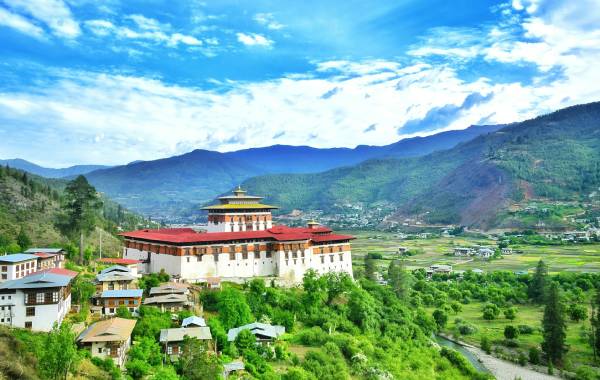
The dzong is Bhutan's signature building. These massive whitewashed fortresses were built from the 17th century onward without a single nail or architectural drawing. Each one holds a district's monastic community and its civil administration under one roof. Highlights include:
- Punakha Dzong, the "Palace of Great Happiness", at the meeting of two rivers.
- Paro Rinpung Dzong, overlooking the Paro valley and home to the spring Paro Tshechu.
- Trongsa Dzong, the largest dzong, once the seat of the royal family.
- Tashichho Dzong in Thimphu, the seat of government and the King's throne room.
Even modern buildings must follow traditional design: sloping roofs, carved timber windows (rabsel) and painted motifs such as lotuses, clouds and the auspicious symbols.
National dress: gho and kira
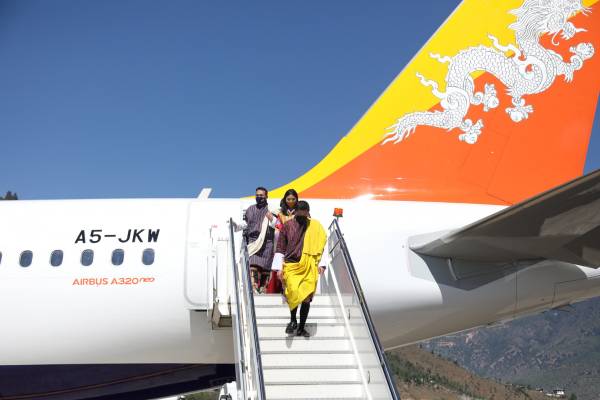
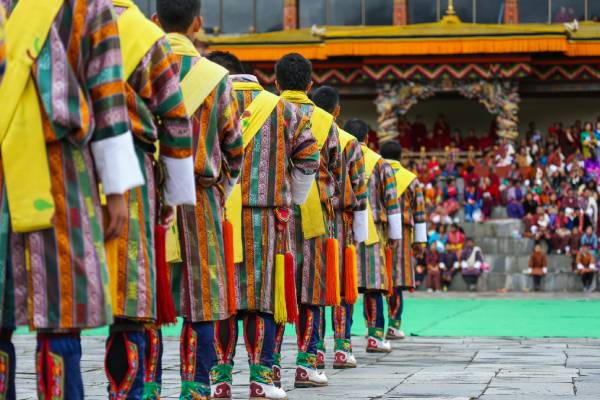
Bhutanese citizens wear national dress at work, in schools and at dzongs and official events. Men wear the gho, a knee-length robe belted at the waist, with long white cuffs (lagey). Women wear the kira, an ankle-length wrapped dress, with a silk jacket (tego) and blouse (wonju).
On formal occasions a ceremonial scarf is worn over the shoulder. For men it is the kabney, and its colour shows rank: saffron for the King and Je Khenpo, orange for ministers, white for ordinary citizens. Women wear a narrow embroidered scarf called the rachu.
Driglam Namzha: the art of good conduct
Driglam Namzha is Bhutan's traditional code of etiquette, set down by the Zhabdrung in the 17th century. It covers how to dress, speak, sit, eat and greet others, especially in dzongs and in front of elders, monks and officials. Visitors are not expected to follow it perfectly, but a few gestures are warmly appreciated:
- Dress modestly (long sleeves and long trousers or skirts) when visiting dzongs and temples, and remove hats.
- Accept food, tea or gifts with both hands. It is polite to refuse once or twice before accepting.
- Never point at people or religious objects with one finger. Use an open hand.
- Do not touch anyone on the head, and avoid pointing your feet at altars or people.
- Ask before photographing people, and never take photos inside temples and dzong shrines.
Archery and national pastimes
Archery (datse) is the national sport and a social event in its own right. Teams shoot at targets about 140 metres away, almost twice the Olympic distance. Each hit is celebrated with dancing and song, and misses are met with good-natured teasing. You may also see khuru (heavy darts thrown at a target) and degor, a game of throwing flat stones.
Family and community
Family ties are strong and many households span three generations. In parts of western and central Bhutan, inheritance often passes through the daughters, and it is common for a husband to move into his wife's family home. Villages share labour during planting and harvest, and annual household rituals (lochoe) bring relatives and neighbours together for prayers and feasting.
Festivals: culture in full colour
Tshechu festivals are the most spectacular expression of Bhutanese culture. Monks and laymen perform masked dances (cham) that teach Buddhist values, and at dawn on the final day many dzongs unfurl a giant thongdrel (sacred scroll painting). See our festival guide to time your visit.
Traveller's tip: Your guide will lend or help you buy a gho or kira if you would like to wear national dress for a festival or farmhouse visit. Locals love it, and it makes beautiful photographs.
Frequently Asked Questions
Do tourists have to wear national dress in Bhutan?
No. Visitors may wear their own clothes, but should dress modestly when visiting dzongs, temples and government buildings: long sleeves, long trousers or skirts, no hats, no shorts or sleeveless tops.
Can I take photographs inside dzongs and temples?
Photography is usually allowed in dzong courtyards but not inside shrines and temple halls. Your guide will tell you where it is permitted. Always ask before photographing monks or local people.
What religion is followed in Bhutan?
The majority follow Vajrayana (Mahayana) Buddhism, mainly the Drukpa Kagyu and Nyingma schools. Hinduism is practised widely in southern Bhutan.
Last updated: 15 October 2026